


What is a pet microchip and the process for registering pets according to the new regulations on animal keeping or release in Bangkok, B.E. 2567
- What is a pet microchip and how safe is it?
- Is microchipping a GPS-like tracking method?
- Pet registration procedures according to the new regulations on the control of raising or releasing animals in 2024 of Bangkok.
This article will answer all your questions about microchipping pets and registration under the new Bangkok regulations.
What is a microchip in pets?
Microchip It is an electronic device as small as a grain of rice. It is designed using special materials that can be implanted in animals for life. It is not harmful to health and does not cause any reaction to the body. And for safety reasons, implantation must be performed by a veterinarian only. The doctor will implant it at the back of the pet's neck, between the two shoulders (except for birds, which are implanted at the chest). Animals that can be microchipped include dogs, cats, birds, etc.
Information inside the microchip For implanting in pets, it is like an identification card for the pet, consisting of a unique identification number of 15 digits. These 15 digits are like a set of keys that will unlock the database of pets that have microchips implanted. This database will specify important identification information of the pet, which can be divided into 3 types:
- Pet information such as name, breed, gender, color, age, etc.
- Pet owner information such as the pet owner's name, contact address, and phone number.
- Information about the hospital that implanted the microchip
Microchip implantation process for pets
At Taling Chan Animal Hospital, the microchip implant procedure is simple and takes 30-45 minutes as follows:
- Bring your pet to Taling Chan Animal Hospital for microchip implantation. No blood test is required before implantation.
- The implanting veterinarian will implant the microchip through an injection using a special needle with a microchip inside.
- Once implanted, the owner waits to receive the microchip implant certification document.
Benefits of Microchipping Pets
- Prevent loss, getting lost or stolen – When our pet is lost and someone finds it and takes it for a microchip test, this microchip will be the one that indicates that this pet has an owner so that they can contact and return it to the owner.
- Microchips don't work like GPS. Therefore, it cannot be used to track the location of pets in real time.
- For international travel – Nowadays, taking our pets abroad requires microchipping. Many countries now have laws requiring microchipping of pets.
- Register for the pet contest – In international pet competitions, it is necessary to implant a microchip before entering to confirm identity, show ownership, and prevent loss during the competition.
- Instead of using a pedigree certificate – When buying and selling pets, having a microchip will help confirm that the pet you are getting is the right one.
- Used to confirm the species – Having a microchip in the father or mother will help us confirm whether the breed we have obtained is the same or not.
At what age can pets be microchipped?
Generally, dogs and cats can be microchipped from 30-45 days of age and above, and if they weigh more than 1 kilogram, but this also depends on the breed of the pet. It is best to consult the veterinarian who performed the implantation.
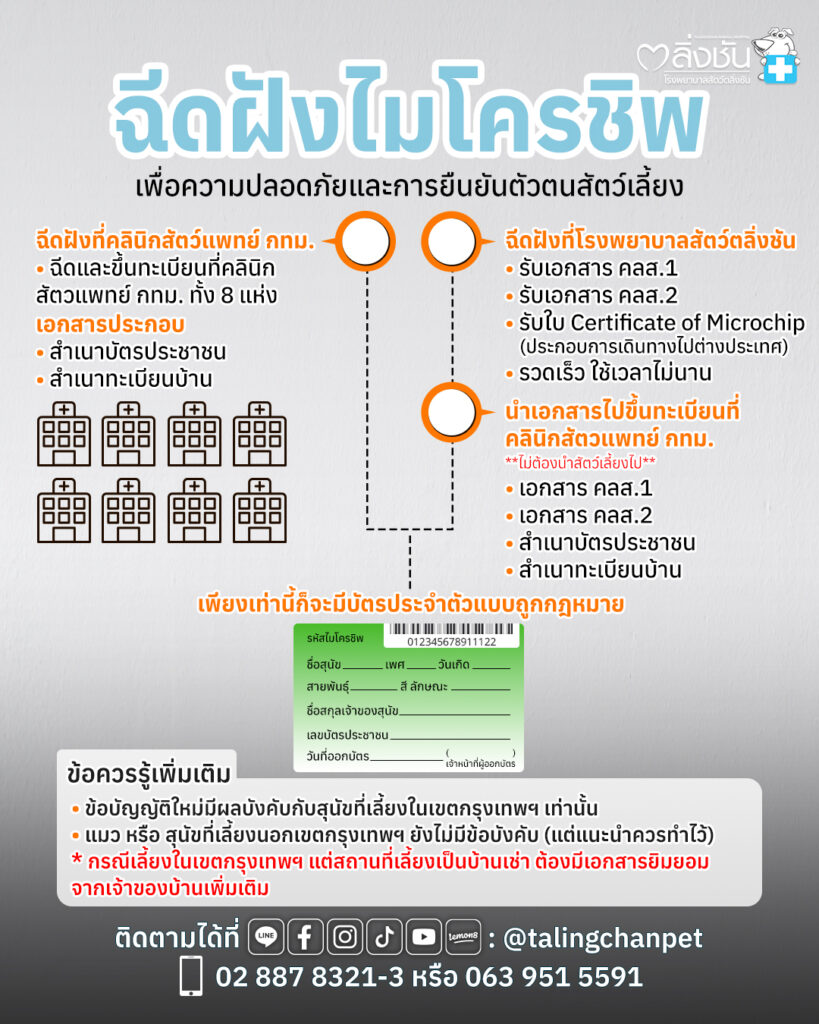
Pet registration process
After microchipping your pet, Taling Chan Animal Hospital will issue a certificate for the pet owner to proceed with the procedure at any of the eight veterinary clinics in Bangkok and at all 50 district offices. (The district office can proceed from January 10, 2026 onwards, referring to the Bangkok Health Department) You must prepare the following documents:
- Certificate Class 1 (Taling Chan Animal Hospital issued the above document along with a 15-digit microchip number sticker.)
- Dog/cat registration application form, Class 2 (Taling Chan Animal Hospital provides documents, but the pet owner must fill them out.)
- Pet owner's ID card
- Pet owner's household registration
In the case of renting a house, the following additional documents are required:
- Consent from the lessor or lease agreement
- Copy of the lessor's ID card
- If you are not comfortable doing it yourself, you can authorize someone else to do it on your behalf.
Where can I register my pet?
- website https://petregis.bangkok.go.th/ For online registration
- Rabies Control Group, Mitmaitri Road, Din Daeng District, Tel. 0-2248-7417
- Veterinary Clinic of Bangkok
- Veterinary Clinic, Bangkok 1, Si Phraya, Bang Rak District, Tel. 0-2236-4055 ext. 213
- Veterinary Clinic, Bangkok 2, Minburi, Minburi District, Tel. 0-2914-5822
- Veterinary Clinic, Bangkok 3, Wat That Thong, Watthana District, Tel. 0-2392-9278
- Veterinary Clinic, Bangkok 4, Bang Khen, Chatuchak District, Tel. 0-2579-1342
- Veterinary Clinic, Bangkok 5, Wat Hong Rattanaram, Bangkok Yai District, Tel. 0-2472-5895 ext. 109
- Veterinary Clinic, Bangkok 6, Chuang Nuchnet, Chom Thong District, Tel. 0-2476-6493 ext. 1104
- Veterinary Clinic, Bangkok 7, Bangkok Noi, Bangkok Noi District, Tel. 0-2411-2432
Registration is not required to bring the pet and must be completed within 120 days of the pet's birth or within 30 days of adoption.
And when registration is complete, you will receive a Form Sor.3 document, which is like a pet identification card.
What must pet owners do according to the new Bangkok regulations?
Raising pets according to the size of the area
- Condo/room for rent, size not exceeding 20-80 square meters, allows 1 pet.
- Condo/room for rent, size more than 80 square meters, maximum 2 pets allowed.
- Houses with land area not exceeding 20 square meters can raise up to 2 dogs.
- Houses with land area not exceeding 50 square meters can raise up to 3 dogs.
- Houses with land area not exceeding 100 square meters can raise up to 4 dogs.
- Houses with land area of 100 square meters or more can raise up to 6 dogs.
In cases where the number of fish raised exceeds the number before the new regulations come into effect, they can continue to be raised, but must be reported to the district office within 90 days after the new regulations come into effect, which is before April 9, 2026.
If raising a special controlled breed of dog, you must notify the district, which is the special breed of dog.New Bangkok Metropolitan Administration Regulations, 2024. namely
- Pitbull Terrier
- Bull Terrier
- Staffordshire Bull Terrier
- Rottweiler
- Fila Brasileiro
- And dogs with a history of attacking or attempting to attack people must notify the relevant authorities to be changed to special control dogs.
Taking dogs and cats out of the premises
- Show your pet's ID card when asked by an officer.
- Use a leash, cage, or other appropriate equipment to avoid harming people or other animals.
- In the case of dogs of special control breeds, a muzzle must be used, a strong leash must be used, and the leash must be held at all times no more than 50 centimeters away from the dog's neck.
- Persons under 15 years of age or over 65 years of age are prohibited from taking special control dogs out of the premises.
Additional information for pet owners preparing to register their pets
- If you have previously had a microchip implanted, you can proceed directly to a veterinary clinic in Bangkok.
- If you want to change the owner of your pet, you must submit an application at a veterinary clinic or district office using the following documents:
- Dog and cat identification cards
- The new owner's national identity card
- The house registration of the new pet house. In the case of a rented house, a letter of consent from the lessor is required.
- If a dog or cat is lost, it must be reported to the police, veterinary clinic, or district office.Within 3 days
- In the case of wanting to move the address of a dog or cat but the owner is still the same, you must notify the veterinary clinic or district office.Within 30 days
- In the event that a dog or cat ID card is damaged or lost, it must be reported to the veterinary clinic or district office.Within 30 days
- If a pet dies, it must be reported to the veterinary clinic or district office.Within 30 days
Penalties for non-compliance
Anyone who violates this Bangkok Metropolitan Administration regulation is subject to punishment under the Public Health Act of 1992 and its amendments (violators under Section 29 are subject to a fine not exceeding 25,000 baht).
refer
https://www.ratchakitcha.soc.go.th/
https://www.oic.go.th/
https://pr-bangkok.com/?p=486402
https://pr-bangkok.com/?p=482998
https://www.facebook.com/bangkokbma/
FAQ: Microchipping and Pet Registration
Q. Is microchip implantation painful? Is anesthesia necessary? And do I need to stay in the hospital for recovery?
A. Microchip implantation is minimally painful because it involves injecting a microchip about the size of a grain of rice under the skin. Therefore, the procedure is similar to a vaccination, so anesthesia is not required, and no hospital stay is needed; you can go home immediately.
Q. Can microchips be used to track pets using GPS?
A. No, microchips don't function as GPS trackers and don't have built-in batteries. Therefore, they cannot transmit real-time location data on a map. The system only works when a "microchip scanner" is close to the pet. So, if your pet goes missing, the person who finds it must take it to a veterinary hospital with a scanner to read the serial number and contact the owner.
Q. How long does the microchip last? Do I need to replace the battery?
A. Microchips last the lifetime of your pet because the chip itself has no battery and no parts that degrade. It works by using radio waves transmitted from a scanner (RFID system). It's a one-time injection; there's no need to surgically remove and replace it.
Q. At what age can pets be microchipped?
A. We recommend vaccination starting from 5-8 weeks of age or around the time your puppy receives its first vaccinations. However, this depends on the veterinarian's assessment of your puppy's physical condition and size.
Q. Is microchipping necessary when moving pets to another country?
A. Absolutely essential! Almost every country worldwide (especially in Europe, America, Australia, and Japan) requires pets traveling into their country to be microchipped with an international standard (ISO 11784/11785) and must have it vaccinated before or at the same time as their last rabies vaccination in order to obtain a travel permit.
Q. What should I do after the microchip has been implanted?
A. The most important thing is "owner registration." Because if you get the microchip but don't fill in the owner's name and phone number in the central database, the microchip will just be blank numbers that can't help track down the owner. At Taling Chan Animal Hospital, we provide an online registration service for you immediately after the vaccination, and we also issue a Certificate of Microchip. However, this form is separate from pet registration with the Bangkok Metropolitan Administration (BMA). Pet registration must be done in person at the district office or one of the eight BMA veterinary clinics.
Q. If I'm not raising my pet in Bangkok, do I still need to microchip it?
A. While burial isn't legally mandatory, it's recommended to do so in case the pet runs away. If someone finds it, they can return it properly.