

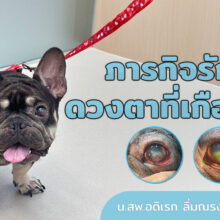
Saving "Mocha's" Eye After Discovering a Deep, Near-Penetrating Ulcer! "Mocha," a French Bulldog, needed urgent eye treatment after a large, 3-millimeter-long descemetocele was discovered in her cornea. This was a highly dangerous condition, almost penetrating the innermost layers of her eye. 👁️ The case required the expertise of a veterinary ophthalmologist, Dr. Adirek Limnarongdech (Dr. Bell). Dr. Limnarongdech used a contact lens designed for animals to support the very thin cornea and reduce irritation…

A cat was rushed to the hospital with symptoms of inability to urinate, lethargy, and vomiting—dangerous signs of urinary tract obstruction. This is the case of "Charles," a 3-year-old British Longhair cat who suddenly became lethargic, vomited, and most frighteningly, couldn't urinate, requiring an emergency hospital visit! 🔍 What happened to Charles? Upon arrival at Dr. Bua's clinic…
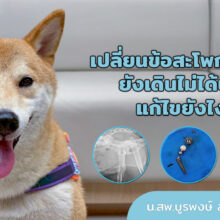
Despite having undergone hip replacement surgery previously, Tora, a Shiba Inu, has continued to experience leg pain for the past year. Before treatment at Taling Chan Animal Hospital, Tora, a 2-year-old Shiba Inu, was unable to put weight on his hind leg, even after a previous hip replacement surgery elsewhere and consistent physical therapy. The owner consulted with Dr. Tang, who concluded that surgery was needed to remove the old hip replacement. What happened to the hip replacement Tora had? During the surgery, Dr. Tang discovered the cause of Tora's chronic pain: a loose material – the metal stem in the femur had dislocated from its original position…

Why do dogs that used to potty in the right place suddenly start urinating everywhere? This is a problem many owners face. Inappropriate urination is more than just a matter of "bad habit"; it's a clear warning sign that something "wrong" is happening to your dog. This could be physical pain they can't express or accumulated stress. But don't panic, because everything can be fixed. First, let's explore the real causes of this inappropriate behavior so we can address the problem correctly. Health Causes: If your dog, who has always been a potty trainer, suddenly changes their behavior… don't scold or punish them. This might not be just mischief, but a physical signal that they're not feeling well…

Microchipping at Taling Chan Animal Hospital: Dogs 1,800 THB, Cats 1,700 THB. What are the benefits of microchipping at Taling Chan Animal Hospital? Microchipping performed by a veterinarian. Required documents for further processing: Certificate of Microchip. Fast process, no long waiting times. Benefits of microchipping pets: Complies with new Bangkok Metropolitan Administration regulations, clearly confirms ownership, useful for international travel, helps in case of lost or stolen pets, allows for pedigree certificate and breed verification.

Many people think that raising rabbits is easy. But in reality, there are many things that people misunderstand about rabbits. This causes many rabbit caretakers to take care of them in the wrong way. Rabbits may seem like gentle pets, not naughty, not loud. But behind the cuteness is the proper care in terms of food, health, and a suitable environment. In this article, we will come to a new understanding of various misconceptions about rabbits that many people may have accidentally believed without realizing it. 1. Main food ❌Myth: Rabbits eat carrots as their main food✅Fact: Rabbits should eat hay as their main food 70-80% Hay, such as timothy hay or alfalfa hay (for baby rabbits), is very important for rabbits' digestive systems. It helps rabbits' teeth, which have grown long, wear down naturally...

Many people may not know that… in addition to humans, pets can also donate their bodies to be “master teachers” for veterinary students to learn about real body structures and help develop treatments for other animals in the future.

Kidney Stones, a problem that causes dogs and cats to be unable to urinate (Urinary Stones) Dogs can't urinate, cats go to the bathroom for a long time but only pee a little bit, or sometimes the urine that comes out is dark with blood mixed in. These problems may be caused by the urinary tract of the little ones that have sediment or mineral crystals accumulated, or what we know as kidney stones. Today, Talingchan Animal Hospital will answer questions about kidney stones for owners to hear what kidney stones are and how to deal with them. What are kidney stones? Kidney stones are caused by the accumulation of mineral sediment until it becomes a stone. It affects the health and behavior of pets. It is a health problem that occurs in the urinary tract. It can occur from the kidneys, ureters, bladder, and urethra...

Many people, including pet owners, already know that sterilization is a permanent method of birth control. However, many people may not know that sterilization for dogs and cats also has other benefits besides birth control, such as reducing the chances of various diseases that may occur in our pets. Today, Talingchan Animal Hospital will share information about sterilization for dogs and cats. Sterilization of dogs and cats * Although sterilization can be started from 4 months old and up, in terms of appropriateness, it is recommended to be done at 6 months old and up for the safety of the sterilized pet. ** Sterilization does not only depend on the age of the dog or cat, but also the weight of the pet must be taken into account...

Cat ear mites are one of the common health problems in cats. Owners may notice abnormalities in their cats, such as frequent ear scratching or dark brown earwax. These symptoms are warning signs that your cat has ear mites. Today, Talingchan Animal Hospital will explain about cat ear mites. What are ear mites? Where do they come from? Ear mites or ears mites (Otodectes cynotis) are small parasites that are invisible to the naked eye. They like to live in the ear canals of animals. These mites can be easily transmitted through contact with other cats, dogs, or pets that already have ear mites, or from unclean environments…