

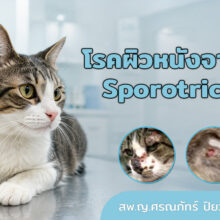
Makrut, a stray cat, approximately 5 years old, was brought in for treatment by his owner with skin sores spreading across his face, nose, body, legs, and tail. The sores were raised, with some areas becoming pitted and filled with blood and lymph. Veterinarians examined cells from the sores and found a deep fungal infection, known as Sporotrichosis. The disease is most commonly caused by the Sporotrix schenckii bacteria, a common environmental pathogen transmitted through wounds or bites. It can also be transmitted to mammals such as dogs or…

Canine Hip Replacement Surgery: Advances in Dog Treatment for Improved Quality of Life. Hip dysplasia is a common disease in all dog breeds, ages, and sexes. Symptoms include difficulty walking, limping, dragging legs, and in some cases, bunny-hopping. In severe cases, dogs may stop walking altogether. Prolonged inability to walk can lead to muscle atrophy and permanent disability. The disease is often hereditary, present from birth. [Images of pre-operative and post-operative x-rays are included.] At what age should dogs be screened for hip dysplasia?

Preliminary skin examination program by Dr. Sem (Dr. Sornpat Piyaworasak) in the Dermatology Department, Internal Medicine Department. Bacteria and yeast examination, skin fungal culture or fungal examination, skin scraping examination for scabies mites, ear mite examination or ear camera examination, ear cleaning. **Including medical equipment fees** Including medical service fees. **Before using the service, you can check the doctor's work schedule at 02-887-8321-3. Return to the Package summary page.

Long-term management of cats with cystitis to reduce the risk of recurrence has 3 simple principles: 1. Increase the amount of water. Increasing water intake is important to help dilute urine and increase the frequency of urination. This prevents cats from holding urine for too long. Roughly calculate by multiplying the cat's weight by 50 to equal the amount of water they should receive per day. 2. Reduce stress. There should be more toys or activities with the cat. Other environmental management such as having enough food bowls and water containers. The litter box should be in a quiet area for the cat to do its business. The cat litter must be scooped and cleaned every day. There should be at least one litter box per cat. Don't forget to separate cats that often fight to reduce stress. 3.…

Heart disease in dogs and cats is caused by abnormalities in the structure and function of the heart. The disease will develop over time, but the final result is a severe condition affecting the heart's function called heart failure. It can be found since birth (congenital heart disease) in the age of not more than 1 year and heart disease in dogs and cats that occurs later (acquired heart disease). The disease develops in the age range from 6 years and up, is the most common characteristic and is often found in older dogs. Heart disease is divided into...

Cancer can occur in both dogs and cats of all breeds. If owners notice any abnormalities, such as an abnormally growing mass in their pet, X-rays or ultrasounds are necessary for evaluation. A biopsy is also required to ensure it's not malignant. Therefore, regular health checkups for your pet are crucial. Early detection significantly increases the chances of a successful treatment. Symptoms include: 1. A tumor that grows larger or expands, often located on the skin or in the abdominal cavity. 2. Non-healing sores, such as ulcers. 3. Abnormal bowel and gastric function…

Dry Eye in Dogs (Dry Eye or Keratoconjunctivitis Sicca, KCS) Another eye disease in dogs that we often encounter is dry eye disease, which is an abnormality of the tear film that coats the eyes, resulting in dry eyes, inflammation of the cornea and conjunctiva. Symptoms of dry eye disease include frequent blinking, large swollen blood vessels in the conjunctiva, swelling of the conjunctiva, protruding third eyelid, mucus or pus, cornea with blood vessels, pigmentation or ulcers…

Wet mange, or scabies, is one of the most common skin problems in dogs. Symptoms often include hair loss, itching, red and inflamed skin, a foul odor in some cases, and the appearance of bumps and scabs. Many people mistakenly think of mange as a serious condition. Mange is caused by external parasites, specifically mites, or scabies mites. These mites are a type of external parasite but are too small to be seen with the naked eye. There are two main types of mites that cause mange in dogs: Sarcoptes mites, which cause dry mange, and Demodex mites…